How much capital should a startup raise?
Why the size of a round should be dictated by the milestone, not the money available
Namaste Dear Reader, I hope you all have been well. For this edition, I thought of writing about the need to accurately identify the amount of capital a business needs before actually raising it.
This comes from experiences I have seen repeat across several startups in our portfolio. It is especially pertinent for founders who are looking to raise their next round.
The common advice today is that a founder should raise cash from investors even if the amount is inadequate to meet the goals of the business. The standard advice is to never reject incoming capital, especially if you are an early-stage startup.
I argue against this.
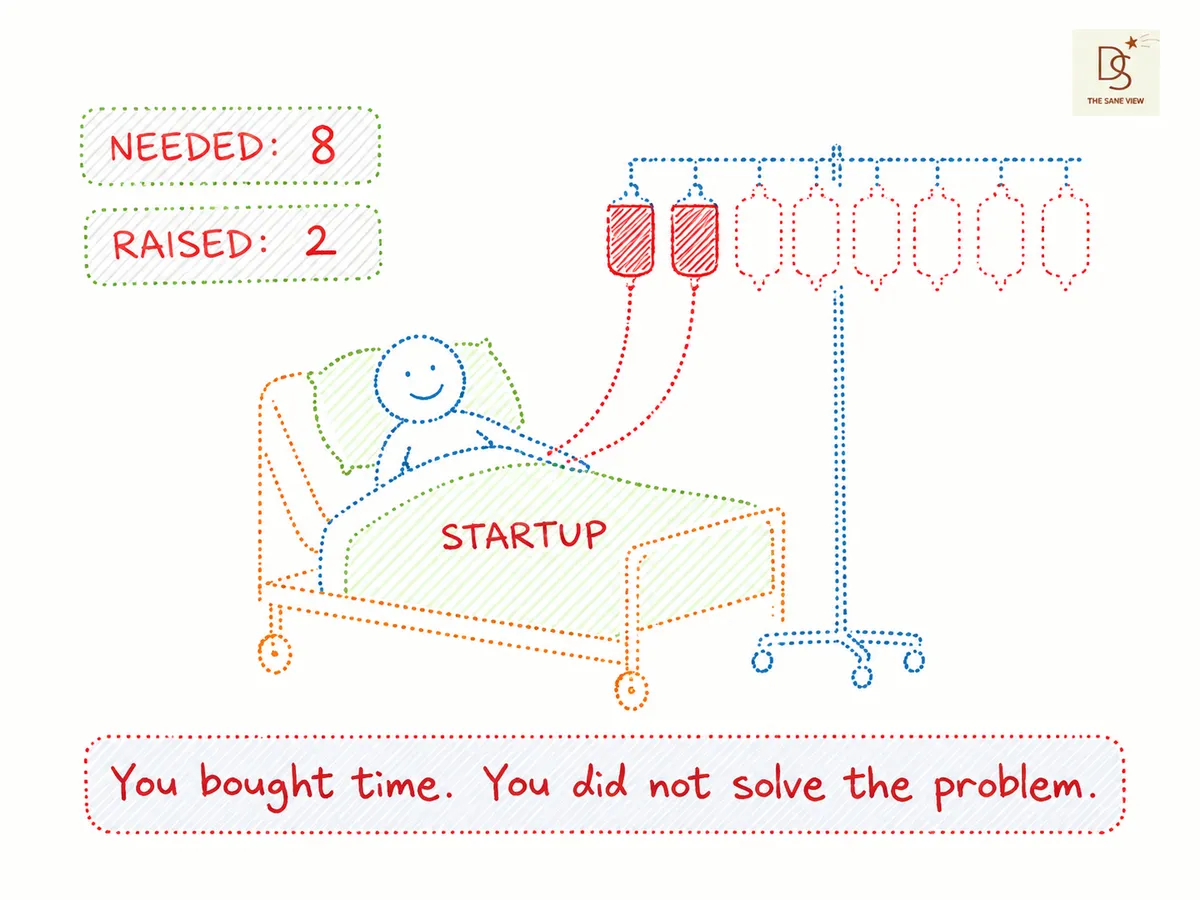
Raising a limited amount of capital when you clearly know that you need more is akin to giving a patient two bottles of blood when he needs eight, as Manish Gupta from Solidarity, who advises us at Malpani Ventures, puts it. You may have bought some time, but you have not solved the problem.
Why rounds get sized incorrectly
Unfortunately, a lot of founders decide to raise amounts that are arbitrarily based on what they feel, or are advised, they can raise at a particular time. VCs are equally guilty. In many of these conversations, investors will say, "We invest X in the round", and the founder then tailors his or her round accordingly. The capital requirement of the business becomes secondary to the cheque size of the investor. While this may work for well-defined categories, say D2C consumer brands, where the milestones and capital required are relatively understood, it almost certainly does not work in most cases.
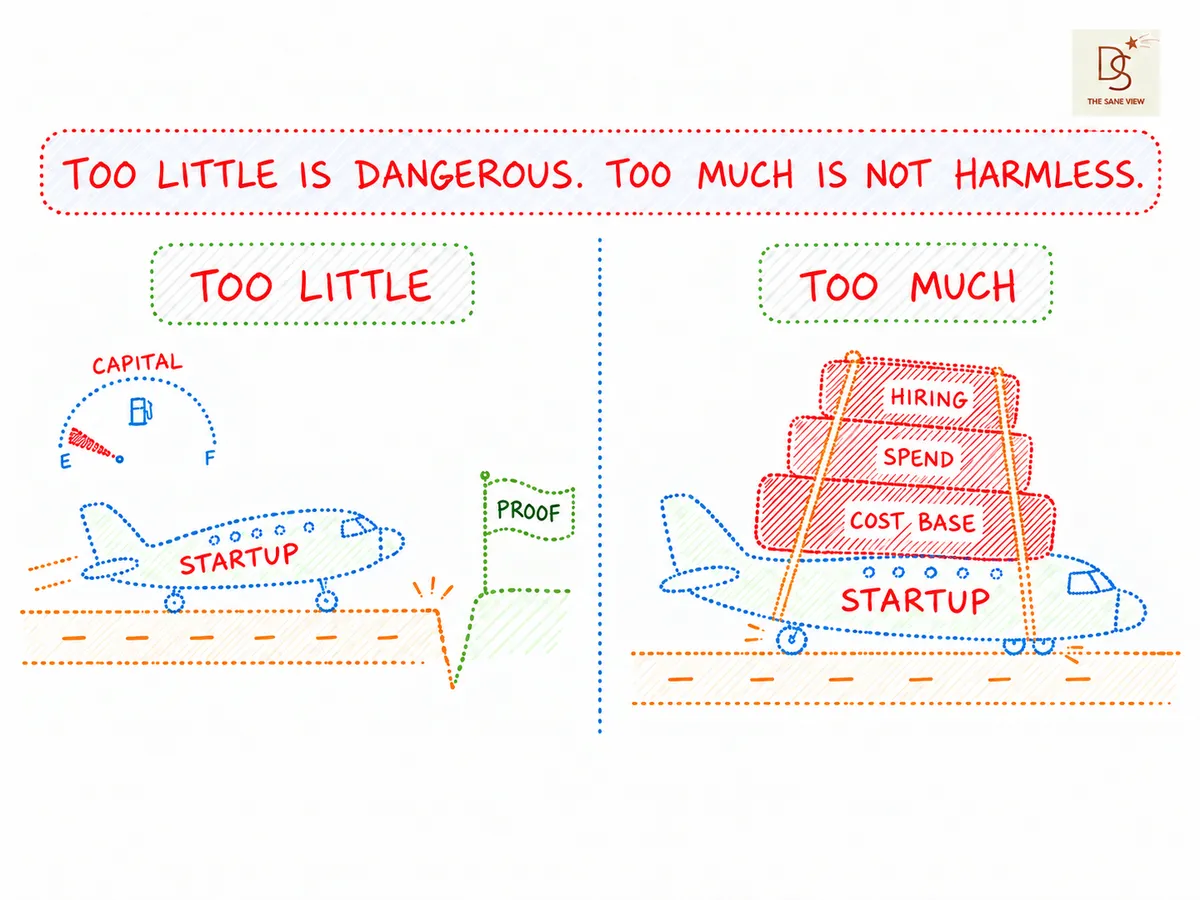
Too little is dangerous. Too much is not harmless.
When a company raises less than it needs, it often enters the next fundraise without having created enough change in the business. The metrics look broadly the same, but the runway is shorter. This is the worst possible position to be in: the company needs more capital, but has little new evidence with which to earn it.
The converse is equally bad and, unfortunately, applies to a large share of VC-funded companies. When you raise more capital than the business merits at a particular stage, it creates a sense of pressure to deploy that capital. In some cases, the founding team ends up outsourcing the hard part of building the business to expensive employees. In others, the company hires ahead of product-market fit or spends on growth before the unit economics are ready. The capital does not create the problem, but it makes avoiding hard decisions easier for longer.
Once the cost base rises, the next round must fund both future growth and the weight of earlier choices. That is not an attractive place to be either. How should one think about the right investment amount?
The cleanest metaphor is a startup as an aircraft: too little capital means the flight ends before it reaches proof; too much turns into excess baggage that the next round must carry.
A simple rule of thumb that I advise is using this framework:
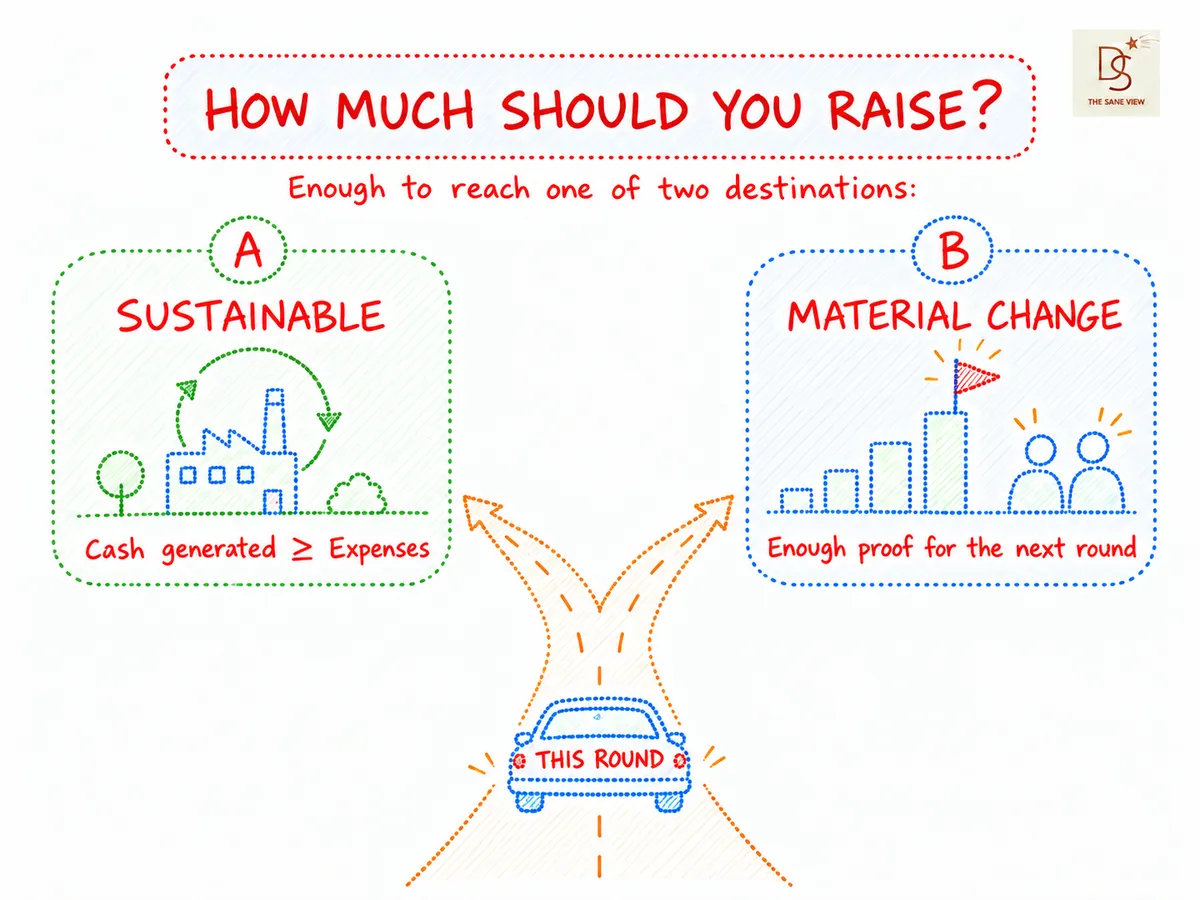
A. Does this quantum of money enable my business to get to such a scale that the business becomes sustainable, that is, it can generate enough cash to cover its expenses?
B. If not, can it create a material change in the business and attract the next set of investors?
If neither answer is yes, the round has not been sized correctly.
If your business needs INR 10 crore of capital to get to a stage where it either becomes sustainable, or it becomes undeniable that there has been material progress, then you should be raising INR 10 crore plus a 15-20% buffer. No more, no less. The buffer is for the fact that plans rarely unfold exactly as expected. It should not become permission to spend without discipline.
Scenario A: Become default alive
Scenario A is ideal and is often scoffed at by entrepreneurs and investors alike. But unless you are building a business that is really intensive in its capital and time demands, for example a true deep-tech company, this is the outcome that you should be gunning for as a founder.
The question I always ask is this: Why would you want to depend on the mercy of strangers once again?
Ironically, if you get to a stage where you actually do not need external capital, that is precisely when you tend to attract a lot of growth-stage investors. This is the situation you want to be in, where you can raise capital purely to accelerate growth and negotiate from a position of strength.
All said and done, raising capital is also dependent on cycles, and you want to be raising during a favourable one. Being default alive gives you the ability to wait for it.
Scenario B: Create enough change to earn the next round
Scenario B is trickier and more subjective to an extent, but it is the only plausible path for many capital-intensive companies. Founders should try to ascertain what it will take for the next set of investors to back them. I appreciate this is tough, especially in breakthrough industries where no former benchmarks exist. The milestone could be revenue repeatability, a material improvement in unit economics, technical de-risking or a regulatory approval. What matters is that the change is specific enough for someone outside the company to recognise it.
A useful hack is to ask existing investors what it would take for them to double down in your company.
It may also be worth speaking to the kind of investors you expect to approach for the next round and understanding what proof they would need. The point is not to build the business around a VC checklist. It is to understand which risk the next round needs to see removed.
But can any founder predict the future?
A rebuttal to the above framework would be that this looks straightforward in theory but is difficult to predict. Given today's uncertain world, how can a founder possibly model the amount of cash needed to crack either Scenario A or B?
Yes, the future is uncertain and it is difficult to carry out this exercise accurately, but that is precisely the point. I would argue that unless a founder has a reasonable estimate of the amount of funds they need, they should not be raising external capital.
A reasonable estimate does not mean a precise forecast. It means knowing the milestone the round must achieve, the monthly burn required to reach it, the time it is likely to take and what happens if the plan slips. The number will still be wrong, but it will at least be wrong for stated reasons.
Should a founder reject a smaller cheque?
Not always. A bridge round can make sense if it gets the company to a specific de-risking milestone, preserves valuable optionality, or gives the company enough time to close a larger round already in motion. However, a smaller cheque is not useful merely because it is available. If it only funds the company for a few more months without materially changing its position, it is expensive postponement. The founder suffers dilution and arrives at the same financing problem from a weaker position.
Likewise, raising more than expected is not always wrong if the founder preserves discipline and the additional capital buys real optionality. But every additional rupee comes with dilution and expectations. Capital should not be deployed merely because it has been raised.
Concluding thoughts
The right question before a fundraise is not, "How much can I raise?" It is, "What must this round make true?"
Capital is useful when it carries a company from one defensible state to the next. If it cannot make the business sustainable or materially more attractive to the next set of investors, it is not enough. If it is far more than required and begins to change behaviour, it may be too much. Raise against the destination, keep a buffer for reality, and resist letting the availability of capital decide the needs of the business.
The round should be tailored to the business. The business should never be tailored to the round